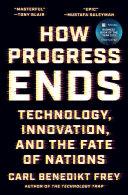
How Progress Ends
How Progress Ends by Carl Benedikt Frey is one of 2026's most credible books, appearing on 2 of the year's most respected lists, including Financial Times, Bloomberg, for a Consensus Score of 34 out of 100.
Appears on these lists
Our take
AI-draftedFrey's argument cuts against the tidy story of technology marching inevitably forward: he traces a thousand years of economic history to show that innovation and the capacity to scale it up pull in opposite directions, with decentralized, competitive systems better at generating new ideas and centralized ones better at deploying them widely. That tension, not talent or luck, is what has repeatedly stalled societies that were once ahead. His live worry is that both superpowers are now vulnerable from opposite ends: China's innovation squeezed by centralized political control, America's scaling capacity squeezed by incumbent firms blocking competition. It's a structural argument rather than a doom-mongering one, built for readers who want the mechanics behind 'progress,' not just the anxiety about losing it.
How the Consensus Score is calculated
Our Consensus Score is our own transparent editorial metric — not a user rating. It weighs each list by the credibility of its source, how recent the listing is, and any award status. Here is the full breakdown.
| Source | Authority | Recency | Award | Contribution |
|---|---|---|---|---|
| Financial Times | 0.93 | 0.85 | 1.10× | 0.87 |
| Bloomberg | 0.80 | 0.85 | 1.00× | 0.68 |
| Weighted sum → Score | 1.55 → 34 | |||
Similar consensus books
Because they appear on some of the same lists.


Frequently asked
What lists is How Progress Ends on?
How Progress Ends appears on 2 lists in our 2026 corpus, including Financial Times, Bloomberg.
What is its Consensus Score?
How Progress Ends has a Consensus Score of 34 out of 100, our transparent editorial measure of how many credible lists agree on it.